
Abstract Art Paintings: How to Choose One You’ll Want to Live With
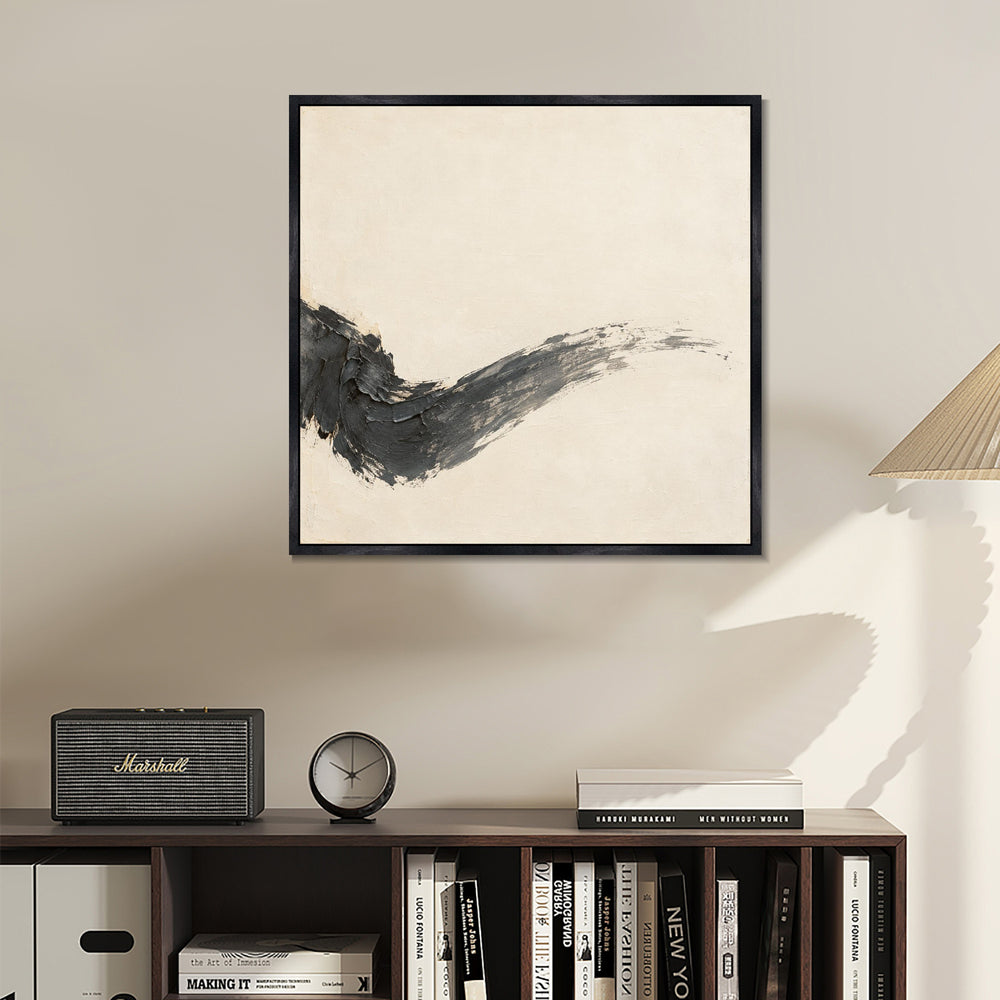
A painting can match the sofa perfectly and still leave you feeling nothing.
Then another catches your eye: a dark brushstroke, a patch of blue-gray, an uneven edge you keep coming back to. You may not know exactly what you’re looking at. You just know you’d like to look a little longer.
That’s a useful place to begin with abstract art paintings. Before thinking about whether a piece fits your decorating style, notice what holds your attention. You’ll be sharing a room with it every day.
INVINART’s Abstract Art collection offers several ways into that decision. Here, we’ll look at three: a quiet, atmospheric composition, a bold painted gesture, and a small arrangement of earthy forms.
What Is an Abstract Art Painting?
An abstract art painting uses color, line, shape, and texture without needing to describe a recognizable subject realistically. Some paintings still suggest something familiar—a landscape, rainfall, a stretch of stone. Others give you brushwork and color with no obvious subject at all.
You don’t need to identify a hidden object to enjoy one.
Instead, notice where your eye goes first. Does it follow a line across the canvas? Settle into a pale area? Return to a small patch of darker paint? Those relationships can be enough to make a painting interesting.
It also helps to separate “abstract” from “modern.” Abstract describes how a painting handles its subject. Modern can refer to an art-historical period, though in home decorating it often means a contemporary look. When choosing abstract paintings for a modern home, focus on the actual composition rather than the label.
Start With the Kind of Room You Want to Spend Time In
Think about the room on an ordinary day, with the books out and a cup left on the table. What would you like the painting to contribute?
A bedroom might benefit from soft transitions and a restrained palette. A hallway might suit a decisive mark you can appreciate as you pass. A living room with patterned upholstery may already have plenty happening; a painting with generous open space could give the eye somewhere to pause.
These aren’t fixed rules. They’re ways to narrow the search before comparing dozens of images.
For a quieter wall: Distant Rain

Distant Rain keeps much of the canvas pale, with darker marks gathered toward the upper right.
In Distant Rain, blue-gray vertical marks hover above a faint horizontal passage. There’s a suggestion of weather and distance, but very little is firmly outlined.
Try this kind of painting where you’ll see it while sitting still: beside a reading chair, opposite the bed, or above a low cabinet. Its lighter areas reward a longer look.
For the surrounding room, start with something you already own. A gray throw or faded blue cushion might pick up a color in the painting. You don’t need to repeat the palette everywhere; one connection is often enough.
For a stronger focal point: A Breath of Ink
Look back at the painting in the opening image. A Breath of Ink has a very different presence: a broad charcoal gesture moves across warm ivory, breaking into thinner, drier traces as it travels.
The contrast makes the composition easy to read from a distance. Up close, the irregular edges become more noticeable.
This is worth considering for a wall you usually see from across the room. In the product photograph, the dark frame and wooden shelving give the painting a clear setting, while the light wall leaves the brushstroke easy to follow.
If your room already has black details—a lamp, chair legs, window frames—this kind of abstract artwork can connect with them. Keep some space around the painting so its movement remains visible.
For soft color with a little weight: Shifting Strata

Shifting Strata gathers its earthy forms low in the composition, leaving a broad area of open space above.
Shifting Strata brings together overlapping taupe and muted mauve forms on a light ground. The uneven contours give you something to study without filling the entire canvas.
It’s an appealing direction if your room uses warm neutrals but you’d like to introduce a little more color. Dusty mauve sits comfortably alongside cream and brown without making the whole room revolve around pink.
The product photograph also offers a useful reminder: abstract art can sit above a decorative cabinet and beside traditional objects. You don’t have to replace the furniture you love to make room for it.
Check the Size Before You Fall for the Room Photograph
A styled photograph helps you imagine a painting at home, but it can’t tell you how a particular size will feel on your wall.
Measure the available space, then mark the proposed dimensions with paper or painter’s tape suitable for your wall finish. Include the frame’s outside dimensions when they’re available. Step back to the doorway, then sit where you normally sit.
Does the outline feel lost above the furniture? Does it crowd a nearby lamp? Would a smaller painting work better on the adjacent wall?
For reference, Distant Rain and A Breath of Ink currently list square sizes of 12 × 12, 20 × 20, and 30 × 30 inches. Shifting Strata lists 16 × 20, 20 × 25, and 24 × 30 inches. Check the selected product option before ordering.
Choose the Frame as Part of the Painting
The frame changes how the edge of the artwork meets the room.
A slim black frame draws a clear boundary around pale paint. A wood-color frame can bring another warm tone into the arrangement. A gallery-wrapped option gives a different edge treatment that’s worth viewing in the product images before deciding.
These three works list black slim frame, wood-color slim frame, and gallery-wrapped options. Compare them against your wall color as well as your furniture. A frame that looks subtle on a white product background may feel much more prominent on a darker wall.
Give Your Favorite a Second Look
Once you’ve narrowed the choice, leave the images for a while. Come back later and see which painting you still want to open.
Perhaps it’s the quiet space in Distant Rain. Perhaps it’s the rough end of the brushstroke in A Breath of Ink, or the small mauve passage in Shifting Strata.
That particular detail matters. It gives you a reason to enjoy the painting after the room is finished and the decorating decisions are forgotten.
Browse the INVINART Abstract Art collection, save a few favorites, and try their dimensions on your wall. Start with the one you keep returning to.