
How to Choose a Hand-Painted Painting You'll Enjoy Up Close and Across the Room
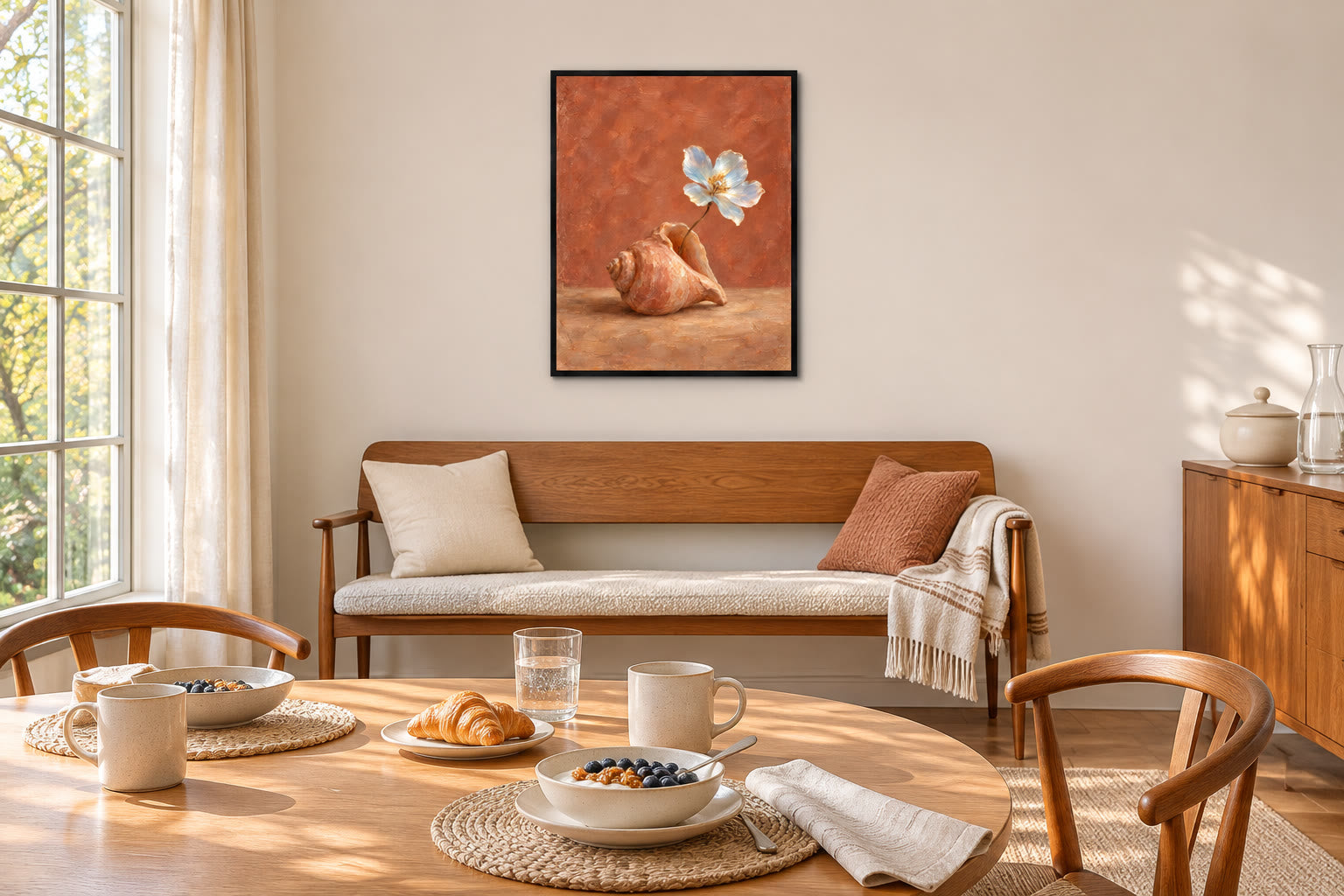
A painting can catch your attention in a small image and become even more interesting when you enlarge it. A few pale marks become the edge of a petal. A dark curve gives a shell its opening. Step back, and the flower becomes the first thing you notice again.

When choosing hand-painted wall art online, it helps to look at both scales. You want to understand the whole composition and the details you might enjoy as you walk past it at home.
Conversations among painters and viewers offer some good questions to bring to that decision. In Reddit discussions about portraits, landscapes and still lifes, people repeatedly move beyond praise to ask where the eye goes, how materials look convincing, and what happens when they zoom in. Here is how to use those questions when choosing a painting for your own wall.
Find the detail your eye visits first
Before enlarging a product image, look at it for a few seconds. What do you notice? A flower, an area of sunlight, a face, or a group of dark shapes? Then look away and see what you remember.
A discussion about a detailed forest waterfall shows why this matters. Some viewers found the painting busy because the leaves, rocks and water all competed for attention. Others enjoyed its richness. The conversation turned to the strength of the highlights and how they guided the eye. Read the waterfall discussion
Try the same question with botanical wall art. In INVIN ART's A White Flower in a Shell, the pale bloom stands out against a warm terracotta-colored background. The shell sits lower in the composition, giving you a second shape to explore after the flower has caught your eye. Consider whether that sequence appeals to you, especially if you plan to see the painting from a dining table or armchair. View A White Flower in a Shell
Compare the small image with a close-up
Bring the image closer and follow one passage. You might choose the edge of a leaf, the turn of a petal, or the shadow beneath a vessel. Watch how one color becomes another.

In a palette-knife landscape discussion, a viewer described how marks that appeared loose at close range resolved into a convincing tree when seen from farther away. In a discussion about an official portrait, another viewer admired the artist's decisions about where to describe detail and where to leave it suggested. Both observations give you a way to explore a painting through changing distance. Palette-knife landscape discussion, portrait discussion
Picture how you will encounter the work at home. Above a dining table, its overall arrangement may be what you see most often. Beside a frequently used doorway, you may have many opportunities to enjoy smaller marks at close range. Browse with that spot in mind.
Explore what makes a material look convincing
Paint can suggest the polished surface of a stone, the curve of a teapot, or a papery leaf. Look at how the highlights and shadows describe those materials.
One oil-painting thread focused on wet pebbles with glossy and matte surfaces. In another, a student who openly identified their work as a copy of an Ellen Buselli painting received praise for the reflections on a teapot. The viewers were responding to the way the painted marks suggested different materials. Pebble painting discussion, student still-life study
The physical paint surface is another detail to explore. A close-up photographed under angled light can help show raised marks. If that matters to your purchase, ask the seller for a surface photograph or a short video taken from the side. A room image helps you imagine the composition in a space, while a surface view helps you inspect the paint itself.
Find the painting style you keep returning to
Some viewers are drawn to fine detail. Others enjoy a broad stroke that makes a form appear with very few marks.
The artist behind a Dolly portrait explained that they used hog-bristle flat brushes. Viewers discussed the broad strokes as well as the sharpness of facial edges. In a snowy-dog portrait thread, the artist described a preference for smooth canvas and a swordliner brush for fine fur. These exchanges show different ways painters use their tools, and different details viewers choose to spend time with. Dolly portrait discussion, snowy-dog portrait discussion
Save a few paintings you like and return to them the next day. Notice which image you open first. If you keep returning to a quiet arrangement with open space, compare it with INVIN ART's Leaves Held by the Wind. Its separate leaves and pale ground offer a different composition from the warm flower-and-shell still life. View Leaves Held by the Wind
Check the listing before you choose
Once a painting has held your attention, confirm the details that affect how it will arrive and fit in your room. Check the materials, overall dimensions, frame option, production time and return conditions. If the work is made to order, ask what variation you should expect between the photographed example and your piece.
Then cut a paper template to the overall dimensions and place it on the wall. Sit in your usual spot and look at the product image again. Follow the main shape first, then the detail that made you want a closer look.

Explore INVIN ART's Flowers & Botanicals collection with those two views in mind: the composition you will see across the room, and the smaller details you will meet as you pass. Browse Flowers & Botanicals